Table of contents
In many countries, citizenship ceremonies are treated as a formality, a short appointment squeezed between errands, yet in 2024 and 2025 they have become a surprisingly visible frontier of politics, belonging and public trust, as governments tighten migration rules, courts scrutinise administrative decisions and communities debate who gets to “be” the nation. These events look symbolic, but symbols have consequences, because they shape turnout, civic integration and even perceptions of legitimacy when naturalisation numbers rise or fall.
Not just pomp: a civic contract
Why does a ceremony change anything? Because it turns an administrative act into a public contract, and that contract is where modern democracies try to anchor loyalty without coercion, and inclusion without erasing difference. The oath, pledge or declaration is usually the final legal step, but it is also a moment of social recognition, with a mayor, judge or registrar acting as a proxy for the state, and with family members witnessing the transition from resident to citizen.
Researchers have long noted that “rituals of membership” do work that paperwork cannot do, and recent policy debates have pushed that point into the open. In the United Kingdom, for example, citizenship ceremonies were introduced in 2004, and Home Office statistics show that grants of British citizenship can exceed 200,000 in a strong year, meaning ceremonies have become mass civic infrastructure rather than niche protocol. In Canada, where Immigration, Refugees and Citizenship Canada routinely administers hundreds of ceremonies a week across the country, the shift to virtual ceremonies during the pandemic raised a practical question with democratic undertones: if the state can confer citizenship through a video call, what exactly is gained by gathering in a room, singing an anthem and hearing a speech about rights and responsibilities?
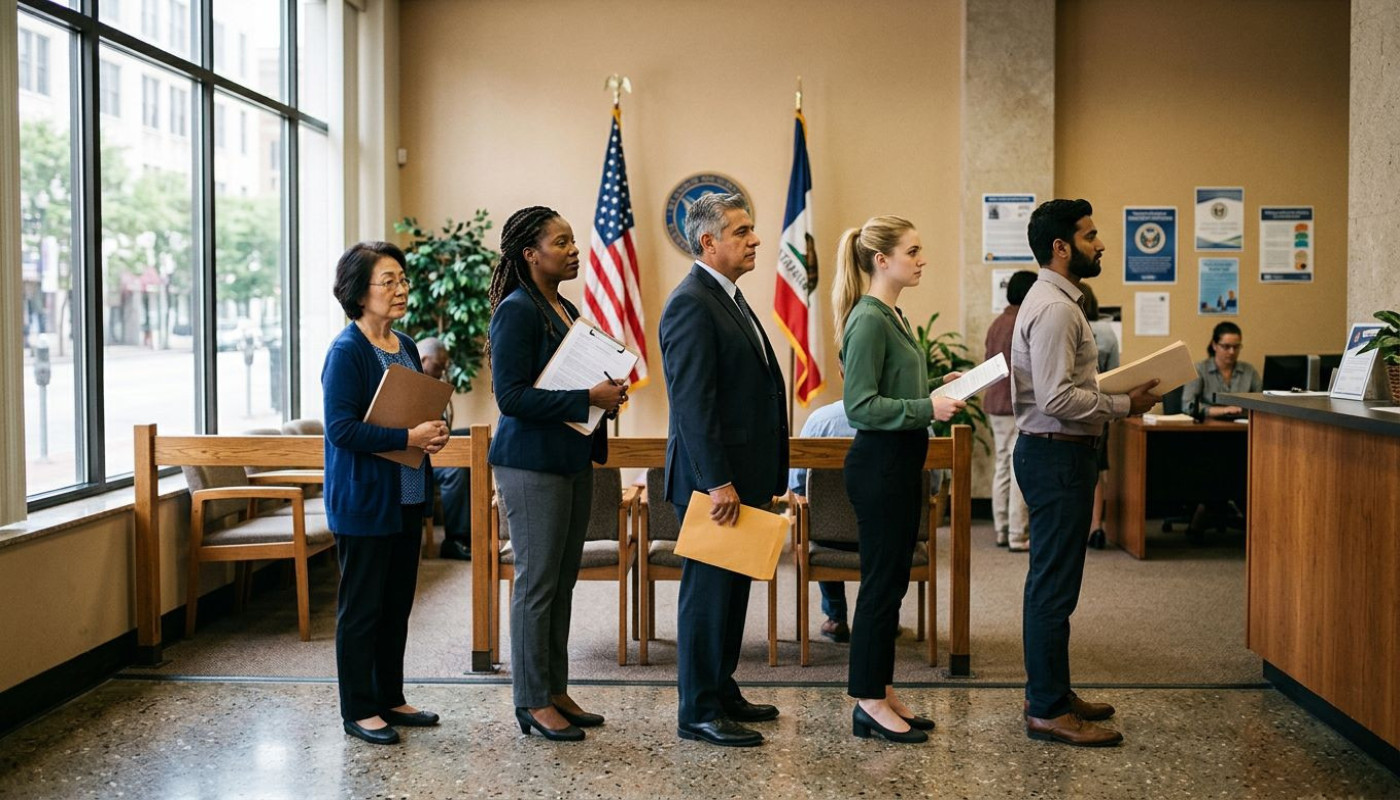
The answer, according to many integration specialists, is that ceremonies create a shared reference point, especially in societies where newcomers arrive through multiple routes, from family reunification to labour migration to protection. In the United States, where naturalisations have typically run in the hundreds of thousands annually and have topped one million in some recent years, USCIS ceremonies often include voter registration drives, civic education materials and community representation. That “last mile” matters, because democracies depend on civic participation, and participation depends on being seen and addressed as a member, not merely recorded as one.
The numbers behind belonging and politics
Naturalisation is measurable, and ceremonies sit at the hinge between statistics and lived reality. Across the European Union, Eurostat data show that more than 900,000 people can acquire EU citizenship in a single year, with totals fluctuating depending on policy changes, backlogs and geopolitical shocks. Germany’s naturalisation figures, for instance, have recently been reported at well over 100,000 in a year, while France also records substantial annual numbers, and those volumes make the ritual side of citizenship harder to dismiss as theatre.
When the pipeline speeds up, ceremonies become a test of state capacity, and when the pipeline slows down, they become a lightning rod for political argument. A surge can trigger claims that standards are being diluted, while a drop can raise allegations of unfairness, administrative obstruction or discrimination. Either way, the ceremony is where the state publicly owns its decision, which is why local officials, civil society groups and sometimes national politicians pay close attention to how those events are run, who is invited, what is said and what is left unsaid.
There is also a more prosaic metric: trust in institutions. Public-facing rituals can either reinforce confidence, through clear communication and dignified treatment, or undermine it, through delays, confusing instructions or an atmosphere that feels punitive. In several countries, applicants describe months of silence followed by rushed scheduling, and the ceremony becomes a moment where frustrations crystallise, not because the oath is the problem, but because it represents the end of a long process. Governments that care about integration outcomes increasingly recognise that “user experience” is not a corporate concept here, it is a democratic one.
And then there is the global comparison that often sits in the background: some people obtain citizenship through residence and integration, while others pursue it through ancestry, marriage or special programmes. That contrast makes ceremonies politically salient, because the public intuitively distinguishes between a person who has built a life over a decade and a person who has acquired a passport by other means, and ceremonies, by design, are meant to signal commitment, not consumption. The debate over what citizenship should mean is not abstract, it is embedded in how, and for whom, the state stages its welcome.
What ceremonies reveal about the state
Watch the ceremony, and you can often read the country. Some states emphasise rights, others emphasise duties, and many try to balance the two, but the framing is never neutral. A speech that highlights voting and equality signals one model of membership, while a speech that centres security and loyalty signals another, and the difference can shape how new citizens understand their place in public life.
Ceremonies also expose a practical truth: citizenship is not only identity, it is administration. The quality of translation, the availability of disability access, the clarity of dress codes and document requirements, and the handling of name changes all send messages about who belongs and how much effort the state will invest to make belonging accessible. Where ceremonies are held matters too, because a courthouse conveys one kind of authority, a town hall another, and a community centre another, and those choices can signal whether citizenship is framed as a legal privilege, a local relationship or a national celebration.
Even small design decisions carry weight. Inviting schoolchildren, veterans’ groups or elected officials can create a bridge between newcomers and established communities, while an impersonal, high-throughput approach can feel like a conveyor belt. Yet governments face real constraints: in high-volume jurisdictions, staffing and venue costs are not trivial, and backlogs can make it difficult to schedule ceremonies quickly. That is where credibility can be won or lost, because the public judges not only the policy, but also the competence and dignity with which it is implemented.
Finally, ceremonies reveal how states handle pluralism. Some jurisdictions integrate religious neutrality tightly into the format, others allow optional faith-based affirmations, and some incorporate multicultural elements through music or guest speakers. These are not cosmetic choices, because they communicate whether diversity is treated as an add-on, a threat or a core feature of national life, and new citizens read those signals carefully. The ceremony becomes a mirror: it reflects the country’s self-image, and it shows newcomers what kind of “we” they have joined.
Citizenship has costs, not all visible
For many applicants, the ceremony is the first time they can exhale, but it is also when the full bill of citizenship becomes clear. Fees, document charges, travel to testing centres, time off work and legal advice can add up, and in some places, the headline application fee is only part of the story. That burden matters, because when costs rise, naturalisation can become stratified by income, and the very people who would benefit most from security of status and political voice may be the ones priced out.
The issue is not limited to traditional naturalisation routes. In the growing global market for citizenship and residency by investment, prospective applicants also face layers of expenses that are easy to underestimate, from due-diligence charges to agent commissions to translation and notarisation. Anyone trying to compare options across jurisdictions quickly discovers that the sticker price rarely captures the full financial exposure, and that is why readers frequently seek clearer breakdowns of the hidden costs of Vanuatu citizenship, including processing fees, intermediary charges and compliance-related expenses that can shift depending on family size and documentation.
Those financial realities connect back to ceremonies in an uncomfortable way. A ceremony is designed to communicate equality of membership, yet the pathways into that room can be radically unequal, and policy-makers are increasingly pressed to explain the gap. Should citizenship be treated as the culmination of integration, where the state invests in making it attainable, or as a premium product with a price tag that filters demand? The answer differs by country, but the credibility of the ceremony depends on the perception that membership is not simply bought, and that rules are applied consistently.
There is also a social cost that gets less attention: uncertainty. Long waiting times can delay travel, job changes and family plans, and the ceremony date can arrive with little notice, forcing people to choose between work shifts and the final step of a process they have already paid for in time and stress. When ceremonies are postponed, cancelled or moved online without clear communication, the state may save money, but it can also spend political capital. In that sense, the “cost” of citizenship is borne not only by applicants, but also by institutions that rely on trust.
After the oath: making membership real
The smartest ceremonies do not end at applause. They point new citizens toward practical next steps, and they make the transition usable quickly, with clear guidance on passports, national ID systems, voter registration, local services and, where relevant, dual-citizenship rules. Budget for fees and documents, book time off early if scheduling allows, and ask in advance about accessibility, translation and name corrections, because the smoothest ceremony is the one where administrative surprises are eliminated.
Similar articles